Dubstar: I Haven't Forgotten You Demo
“So what do musicians do when their bands are over? What do they do next?”
I was in the passenger seat of Mike ‘Spike’ Drake’s car, completely lost in deepest Sussex on the way to Chris Difford’s studio Heliocentric. It was taking us far longer to get there than we’d imagined and conversation was running low:
“Some become taxi drivers…” said Spike, “work on building sites. I dunno…”.
It was getting dark, rain splashing up from the drenched B2089. I wasn’t satisfied with that so I persisted, like a ten year old pestering an irritated mother:
“But they can’t just stop making music. Like Tony Mansfield. I was a massive fan of his in the eighties and I haven’t a clue where he’s gone…”
I hoped Spike would know but I got nothing, he was concentrating on the road. To this day I don’t know what happened to Tony Mansfield.
But in that car I was well aware that I didn’t know where I was going either. It was February 1999. In eighteen months Dubstar would be over.
SONGWRITER FOR HIRE
There had been a long hiatus between the making of Make It Better and its release, and during this time I’d worked with our manager to set myself up as a writer for other artists in order to avoid, as Spike had predicted, ‘becoming a taxi driver’. The best thing to do would be to capitalise on Dubstar and my visibility as the act’s songwriter before the ‘brand’ evaporated. That meant transitioning from writing for my own act to writing for everybody else's, a role I performed for the best part of seven years.
I loved it.
I spent so much time writing in Stockholm, the world’s musical capital, that it became my second (or should that be third?) home. Even considered moving there for a while, until I experienced my first Swedish winter. Brrrr…
I did alright as a writer for hire though (I’ve included a handful of examples of what I got up to here), have many stories to share, certainly made a comfortable living and I’ve occasionally returned to that world since I finished working with Chris and Sarah in 2014. But after a few years at it I had a growing problem…
The memories of how Dubstar ended were fading away. One night in mid 2003 I revisited the songs I’d written as the curtain was falling and realised that I’d accidentally gotten my writing mojo back right at the end of Dubstar, right after the struggles with Make It Better. I Lost A Friend is a great example of this.
I had a nagging and growing sense that Dubstar had more to say, maybe it had ended too soon? I listened back to ‘I Haven’t Forgotten You’, ‘Leaving In The Morning’ and ‘The Last Song’…maybe there should be more Dubstar?
Also, I’d had a unique experience working with a then unknown local Sussex band called Keane. I’d been called in by David Field at BMG to work with them and we did a great session at Kevin Stagg’s studio just round the corner from the Booth Museum in Brighton. We remained friendly for a year or so after; consequently I had a front row view of their ascent into super-success.
What was so inspiring was after all the difficulties I’d faced as Dubstar fell apart, I saw that the good guys could actually win in the end. And not just win, but create something truly remarkable. Keane’s Hopes and Fears, which actually was recorded at Heliocentric unlike Make It Better, remains one of my all time favourite albums. And as Nick Gatfield, their A&R man at Island Records who also signed Dubstar in the USA said in an interview…the formula for Keane’s success was timeless and simple:
‘great songs sung by a great singer’
Dubstar had those. Dubstar could do that.
DUBSTAR AGAIN?
I’d worked with other singers on new artistic projects in this period too. There was Lily Fraser from Cornwall…we wrote a song called ‘Down’ together which I would play in A&R meetings for years after. It’s the song that got me the Keane gig and countless other opportunities. And of course there was the amazing Cat Goscovitch who I’d accidentally met at a party in Jesmond in 2003 having been a secret fan for years. We wrote lots of great music together.
But it’s a different dynamic creating a new act from scratch when you’re in your early thirties rather than your early twenties. With every other act I’d been in we’d been friendly before we realised we could do music together. Starting with music in mind is a different process, like the difference between meeting ‘a friend of a friend’ as opposed to meeting someone on a dating app. I couldn’t make it work, and of course even if I had…
It wouldn’t be Dubstar. Which meant no matter how good the music was we’d have had an enormous uphill struggle getting any attention in the millennial media. That struggle is fine when you’re young and callow and willing to sacrifice years of slog to get somewhere.
But I’d already been somewhere. In fact, because I’d been writing extensively with other artists for years I’d done this all before, I knew exactly what difficulties lay ahead. That’s the burden of experience I suppose, of maturity.
So if it was going to be art it had to be Dubstar, because Dubstar worked. Dubstar had a track record and a ready made and receptive audience. And of course, that meant it had to be Sarah up front. But Sarah was in Client making music that was as far away from Dubstar in sound and intent as they could make it. Would she be up for it?
Chris had been in regular contact and sounded her out, repeatedly I later discovered. So Sarah and I met in a bar near the waterfront of the Thames with her boyfriend and their friend Steve Strange, the legendary promoter who sadly died last year. Her answer was yes, there would be more Dubstar. Hooray! I opened my songbook where I had secretly been writing more Dubstar for years and we were off.
It was late 2006. We were back and ready to take on the new millennium. What could possibly go wrong?
Stay tuned.
I Haven’t Forgotten You
This is a demo recorded in late 1999. I can’t recall what it was for but I do know that I recycled some of it for Drycker Stor, a collection of classical pieces I wrote for Audrey Riley’s ‘A Change of Light’ the following year.
I hadn’t thought about this song in many years until I found it on one of the archive hard drives earlier this month. I couldn’t find a version with the vocals to the verses or middle eight and was tempted to overlay myself singing it, or maybe using Emvoice to sing it (which sounds remarkably like Sarah). But that’s not the spirit, I thought it better to leave the demo as is and instead provide the words. After all, the song you can hear in your imagination is undoubtedly better than my interfering with a twenty two year old recording.
I Haven’t Forgotten You
A life short lived
With no final word to share
Laments left in letters
And told in prayers
I chose to leave goodbye unsaid
But I meant to let you go
(With) All my memories, the moments that we shared
I haven’t forgotten you
For every phone call and letter I ignored
I haven’t forgotten you
But this apology
Might suffocate you as I stand
Under shadows of regrets and broken plans
It’s too late to tell me
But you wouldn’t let go
I have the souvenirs of your suffering
And here are mine so
(hold out your hands and)
Take my fear, take away my shame
I haven’t forgotten you
In my excuses and everything I blame
I haven’t forgotten you my love
Spoken:
Feeling a little sad in the mornings is so normal
I hardly notice now
All my memories, the moments that we shared
I haven’t forgotten you
For every phone call and letter I ignored
I haven’t forgotten you
Take my fear, take away my shame
I haven’t forgotten you
In my excuses and everything I blame
I haven’t forgotten you my love
Want more? You can find the story behind every Dubstar song ever recorded including dozens of unreleased songs right here at Dubstar.com
And don’t forget to follow me on Twitter for up to be the first to hear new releases and up to the minute news
Dubstar: No More Talk Demo
“You have your whole life to write your first album, and three months to write your second”
The pressure was on. Disgraceful had been certified gold and was well on the way to reaching platinum album status. Every single we’d released had made the charts, we’d even had two bona fide hits with Not So Manic and Stars. Now we had to do it all again, and that’s probably a harder task than doing it the first time. Any fool can write a hit album, but can he write two?
I rolled off the train at Newcastle Central station. It was the 30th of December 1996 and bitterly cold. No one was around, the platform was deserted but I had a mission: to write and record four hit singles in a month, then breakdown and clearout the studio at the Newcastle Arts Centre. I also had to move out of my flat in Jesmond and move to Brighton. I’d partied hard in Newcastle upon Tyne like a student who never attended a lecture, but after nine years it was clear that I’d learned everything this fantastic city could teach: it was time to graduate and head back south. Sarah had already moved to Manchester by this point, and although we didn’t know it at the time, the three members of Dubstar would never live in the same city again.
So I spent January 1997 in the freezing cold Arts Centre alone (there was still no heating) completing four new Dubstar songs:
But what had led me to accept this mission? It was the consequence of our first trip to the USA…
What happens in Woodstock…

Sarah loves the new artwork
Let’s Go and Inside were written at Bob Clearmountain’s house in Woodstock. We’d spent a couple of weeks in the USA working with Stephen Hague in his barn near the acclaimed Bearsville Studios. These were the first recordings for the second Dubstar album, provisionally entitled ‘Death Is The End’. I’d spent most of my time writing in one of Bob’s back rooms using an Atari ST computer and my Roland JV-1080.
It was an exciting time. In between recording sessions Chris, Paul (Wadsworth) and I would hang out in the enormous lounge listening to Depeche Mode’s Violator album. We had superb caterers from a restaurant in the neighbouring town who would deliver vegetarian food for us every night. Sometimes we wandered through the forest and down the hill in the snow to the Tinker Street Tavern where a selection of entertainers would perform. They weren’t Borsch-Belt comedians, but mad performance artists from New York City looking to capture the Woodstock spirit. Or maybe they were making the spirit themselves?

The bar itself was tiny, smaller than a typical British pub. I remember seeing a Native American country act one night, complete in Hollywood style head dresses. And there was this one guy, a solo act with a guitar who spent ages doing a preamble to his song. He then played the song (which was a bit odd, but nothing we couldn’t handle), after which he told us he would ‘now restring my guitar’. After fifteen minutes he walked off from the stage without saying another word.
I loved it.

Me in Woodstock with Goatee. It’s a different colour today
Later that trip we got stuck in a different bar with Stephen Hague, fellow producer Stephen Street and a new band called Travis who were recording at Bearsville. The police had closed both ends of the road out of Woodstock and were stopping and breathalysing everyone in their cars.

Snow in Woodstock
Of all the times we’d wandered into town, it was this night that I’d driven down the town to avoid getting caught in the blizzard. I thought driving would be fine as we’d need to keep a lid on our drinking…. this was our last night in Woodstock and were travelling to NYC and then Manchester the following day. Unfortunately I’d parked the car on the other side of the police cordon and had come out without my driving licence or any other kind of ID. That wasn’t going to go down well with the cops.

Another busy day watching Bond movies at Bob’s
This became the biggest night of our stay in Woodstock as we went for it in a big way. There no choice, we had to stay in the bar until either the police had gone to return to the car (not a good idea) or until the blizzard subsided so we could walk back up the hill to Bob’s place.

Sarah and Paul keeping warm in NY
That’s what we did. At 3am.
And inevitably we missed our flight home. It was December the 23rd, the record company offices in London were closed, no one had booked us a car from Penn Station to JFK and we had no idea how to make our own way to the airport. We hailed a yellow taxi, got stuck in the tailbacks from Manhattan, had a couple of panic attacks and missed the flight to Manchester by half an hour. We were now stuck in the States. Damn.
I didn’t care though. I was just as happy to spend Christmas in New York City with my credit card than fight for a space on another flight. But that wasn’t what Paul and Chris had planned (Sarah was staying on in Woodstock with her boyfriend) so we soldiered on. We were lucky, there was another flight a couple of hours later to Heathrow and we could sit at the back next to the toilets.

Xmas shopping in NYC
This was perfect for me as I needed the toilet and was heading to my parents for Christmas in Orpington anyway. The boys had to make their own way back to Newcastle though, tired and hungover. And a little hysterical, as they told me later.

Graphical illustration of the trip home from NYC by Chris Wilkie aged 23
Back to Newcastle
Andy Ross from Food Records had told me that one of the great things about Disgraceful was that we were spoilt for choices for singles. I hadn’t liked the sound of that. At the time I was listening to 4AD artists like His Name Is Alive, Red House Painters and Tarnation, all of whom made sprawling albums that included songs of various styles and lengths. That’s what I wanted for Dubstar, an album that said ART! Sure, you had to have singles, I knew that. But why not also have songs that have no role other than to be on an album?
Consequently I’d written shorter songs like Polestar and Let’s Go that could be heard as vignettes between the bigger songs like Say The Worst Thing First and I Will Be Your Girlfriend. I was writing an album. At least that what I thought was happening. We’d resurrected a brace of old songs from The Joans era too for consideration (Can’t Tell Me, It’s Clear, Wearchest, Girlfriend)…In a sense, Death Is The End* was a ‘second pressing’ from the repertoire that had existed from The Joans and earlier.
But by 1997 I’d changed my mind, Andy was right. We needed more songs that sounded like singles, songs that could get on the radio. So I wrote Inside and resurrected a tune I’d written many years earlier…

The No More Talk remixes promo, including my long lost mix
NO MORE TALK
The main components of No More Talk were written in the late Spring of 1987 when I was at school. It was a hybrid of three different tunes, just like Week In Week Out. The verses and pre chorus were from one piece, the synth lead lines from another and the chorus from a different song that was written a few months later. They were combined as No More Talk a decade later at the arts Centre. As usual I wasn’t sure if the song worked until Sarah sang it, but when we heard the layered vocals in the chorus I was sure. This would be a single, no question.
And it was.
What about that sample at the beginning of the song, the one that sounds like it’s from Yes’s ‘Owner of a Lonely Heart’? Nope. It was actually from a CD-ROM call Gigapack, a sample library by a German company called Best Service. It turned out that they’d sampled it from an entirely different library for the Fairlight CMI, which is how the same sample had ended up on both songs.
When I was asked about this in interviews I would say that it was part of the Dubstar plan to have a sample from a song with a sad title: ‘Owner of a Lonely Heart’ was ideal, especially as No More Talk was (yet another) melancholic song from the act. The truth was it was entirely an accident, like almost everything that happened in the Dubstar days.
Two months later the recordings were completed with No More talk as the lead single for the second album, now entitled ‘Goodbye’. It would reach number twenty in the UK. We appeared on Top of the Pops again, and when we left to get the night train to Glasgow we…well that’s another story for another time. Sorry.
——————————————————————————
That chart position was a disappointment at the time but I every now and then I think about the seventeen year old me writing little songs on his parents’ piano.
He was dreaming of being in a tiny indie band on 4AD, or Factory, or Rough Trade. Or anyone really. If you had told him he was writing a song that would get him on Top of the Pops he’d say you were mad.
But secretly he would have been ecstatic.
Want more? You can find the story behind every Dubstar song ever recorded including dozens of unreleased songs right here at Dubstar.com
And don’t forget to follow me on Twitter for up to be the first to hear new releases and up to the minute news
Dubstar: Haunted
The final public Dubstar album was Make It Better, released in August 2000. But what exactly was the Dubstar EP from later that year?
Following my first departure from the act in June 2000, Parlophone released Make It Better and an accompanying EP. I hadn’t officially informed anyone except Chris that I had departed, but the fact that I was not around for the Self Same Thing video sent a pretty clear message. I hadn’t kept it secret that I was working with other acts either…
Despite the anaemic first week sales of Make It Better, Tommy Manzi, our American manager had managed to convince Parlophone to appraise some new material from the act. Although he didn’t put it this way it was clear: this was the last opportunity for Dubstar to stay on the label.
Which put me in an odd position: as far as I was concerned I’d left Dubstar, but here was an opportunity to write and record more material to test if there was a future for the act with EMI. I didn’t expect them to want another album, and I definitely didn’t want to make one…but why not give it a go? What was there to lose?
So we recorded six tracks. I wrote four new songs, reused ‘Leaving in the Morning’ that I’d written for Jo Morgan earlier that year and threw in a cover of Fiat Lux’s ‘Secrets’. There was a clear sonic progression between these tunes and those on Make It Better. There was a return to the lyric led writing that characterised Disgraceful and Goodbye and was sorely missing from Make It Better. The heavy guitars were gone, as was the vitriol. The synthesisers were back, and as these were the first recordings I’d made using internal software instruments…suddenly Dubstar sounded millennial.
And like the arrangements on Disgraceful, Haunted was inspired by the songs I was DJing at the time. I was fascinated by UK Garage and Breakbeat and wondered if there was a way of incorporating those awkward rhythms into my own work.
Haunted is the result. I think it almost works, in fact there’s a lot going on here that’s promising. Sarah’s disconnected vocal sits nicely with the floating progressive pads, the beats are good. What lets the tune down is the song itself…the verses are fine and include the word ‘frothing’ complete with a repeat of the word as a callback. I didn’t realise it was funny at the time but Chris and I would fall about laughing at it later…
But the chorus isn’t up to much. All of the components are there but it doesn’t take off… ultimately the implied excitement isn’t earned. And lyrically, it feels like a songwriter’s song. More about that problem another time.
Overall I like Haunted, and if there was to be a future for Dubstar in the early 2000s I do think these millennial beats could have been a fruitful approach.
But it was not to be.
On the morning of November 17th 2000, Tommy was on the phone again. Parlophone were not picking up the option for another Dubstar album. No explanation needed. It was over.
I knew what I had to do.
I took a taxi from my apartment on the seafront in Hove to Brighton station, rain crashing down on the windscreen from a slate-grey sky. The driver wondered where I was going?
Me: ’London’
Driver: ’Doing anything exciting?’
Me: ’Yes. I’m off to tell everyone in my company they’re out of a job’
He went quiet, I think he was expecting a jollier response.
Driver: ‘…not a great day then’
Me: ‘Not exactly’
The rest of the ride passed in silence, as did the train journey.
Musicians hope their day in the sun will last forever, but nearly every act is dropped eventually. It’s actually not that big an event, it’s not really an event at all. There are no summons to the record company, no fights, no solicitor’s letters, not even a rejection… just a decision made at a meeting whether or not to ‘pick up the option’ for more of your music. It took seconds. You’re not there so you don’t even get taken to the pub in commiseration. The clear disintegration that had occurred and Dubstar’s lack of sales, meant it would have been a brave decision to pay for more.
And no one was being brave.
So I made it to Chris and Sarah’s flat in Belsize Park and broke the news. I think they were saddened but not shocked. After all, the writing had been on the wall for years. There wasn’t much to say…there was no discussion of getting another record deal, playing gigs or keeping the act going in any form. We’d come to the end of the line. I don’t remember much else about that afternoon except I didn’t hang around for long, and it was raining as hard in London as in Brighton.
And that was it, Dubstar was over. Two days later I was invited up to Cumbria to write with Mark Owen for his solo album, and another chapter began…
_____________________________________________________
Twenty one years have passed since that day, plenty of time to reflect. I discovered about a year later in 2001 that there had been significant surprise and some disappointment that Dubstar had folded at that point. On paper it might have made sense to keep going…we were still getting into the UK charts, Stars, Manic and No More Talk were still being played on the radio (and remain on repeat to this very day). The ‘brand’ was still strong and apparently considered ‘cool’…
But by the end of 2000 Dubstar had no label, no manager, no agent, no producer, no songwriter and no publisher. There was nothing to keep going. It would remain that way for six years.

Dubstar: Stars Steve Hillier's Glitterball Remix
My gift to Dubstar fans this Christmas is my new Glitterball Remix of Stars. This song was a defining moment in my career which propelled Dubstar into the spotlight, continues to be played on radio stations across the world and even quoted in pop culture including Dr Who. I could only have dreamed of this success when I wrote the song back in 1992.
Stars was the lead single from our album Disgraceful album which also had a remix sister album featuring some of our favourite producers including Way Out West alongside my own remixes and vignettes. These were all put together at Newcastle Arts Centre. It was a lot of fun.
I also made an early version of this remix of Stars. I suspect it wasn’t included on the album because there were already two versions of Stars plus there were two remixes of other tracks from me and my new version of the Stars Remix was…incomplete, to put it mildly. It sounded good, but simply wasn’t finished. So it landed on the cutting room floor.
Fast forward twenty five years…
I rediscovered this long lost version on one of the hard drives that came back from Puerto Bañus and was blown away. Honestly, I hadn’t thought about this remix in all that time and was struck with how the ‘feel’ of it might not have been ideal not for the 90s, but was spot on for the 00s. And seeing as the Millennial revival officially started this year, I thought this was the time for it to see the light of day.
But there was a problem. It was as clear to me in 2021 as it was to the A&R team in 1996 that my version was unfinished. The component parts were long gone, decaying in a landfill somewhere. What to do?
To bring you this Christmas gift I reassembled the remix from scratch, replayed live all the parts that I’d previously programmed (bass, guitar, two synthesizer solos including one on the Roland JD-800 and one on the Monopoly), went back to an early Stars vocal and retimed the words BY HAND (no time stretching on this version)… and this is the result. Dubstar’s Stars, the Steve Hillier Glitterball Remix.
I hope you enjoy it, I suspect this will sound great at the office Christmas party tonight (covid permitting).
Merry Christmas everyone, and a very happy and prosperous New Year to you all.
STEVE Brighton 17/12/2021
Dubstar: Poupée de Cire, Poupée de Son Non-Broadcast Mix
Poupée de Cire, Poupée de Son, a cover of the tune France Gall had won Eurovision with in 1965, was the last song from Dubstar’s Goodbye era, and the final time that the act performed on national UK TV. I’ve documented elsewhere it’s to my ongoing annoyance that I submitted the wrong mix to the producer for broadcast on Channel 4. But good news! After twenty four years in the wilderness I found the correct one on the hard drives that came back from Puerto Bañus.
I’ve covered some of the story behind our appearance on Eurotrash here, but as with everything Dubstar there’s always more to the story. So exactly what happened here?
In the spring of 1997 I moved from Jesmond in Newcastle upon Tyne to Waterloo Street in Hove, into a house formally known as the Peach House Hotel. It had been a brothel, three of the five bedrooms had baths with mirrors strategically positioned so you could see everything that might be going on inside. It was beside one of these that I setup up the studio that had previously been resident at the Arts Centre in Newcastle. Returning to the South East of England after nearly a decade, I was unaware of how expensive it would be to setup the studio like we had in Newcastle. Also, there simply was no space to rent, even in a seaside town.

Tom Cruise saved the world with one of these believe it or not
So I persevered with this ridiculous situation and a ridiculous combination of then state of the art equipment, such as the Mac PowerBook 5300 and the totally archaic…my monitors were a pair of hifi speakers I’d inherited when I was at school in the 80s. Perched on the lip of the bath.
Obviously this was not sustainable. Mixing was impossible, I had to complete the writing and recording in my bedroom then take the parts up to recording studios in London to finish them, into rooms and onto desks I was entirely unfamiliar with.
Also, the ADAT recorders we’d bought just eighteen months earlier (and recorded all the B-Sides for Disgraceful and most of the demos for Goodbye) had already failed. What had been a technological godsend in 1995 were now obsolete. So Poupée de Cire, Poupée de Son was recorded on the Roland VS-880. A self contained hard drive recorder and mixer, it had solved many problems in Newcastle but even that had begun falling apart within a year.
And then I had to complete the music for Channel 4. Within forty eight hours.

So after bouncing a rushed mix for Sacha Distel’s management, the VS-880 broke, losing all the recorded data. There was no way to recreate the vocals and guitars in time either….Chris was living in Gateshead, Sarah in Manchester. Geographically speaking, the band was no longer together.
So I bounced down a version to DAT, but the version Sacha would sing to had no bassline. I’d accidentally muted the Korg Monopoly that chugged away in the bottom end and hadn’t noticed in my panic because this was all put together in a fucking bathroom. I rushed up to the post office at the top of Little Western Street and off it went to Paris…no possibility of transferring it by internet, all I had was a dial-up connection and mp3s weren’t a thing in 1997.
I didn’t notice until the very day we did the TV recording for Eurotrash that the baseline had disappeared. It was with horror that I realised my mistake as the tune blasted out of the TV studio monitors.
But now it’s back. I discovered an earlier mix of Poupée de Cire, Poupée de Son with the Sacha bits left out so he could add them later in Paris. I found Sacha’s original vocal acapella too so I recombined them over a glass of Côtes du Rhône in my proper studio… so here, twenty four years later we finally have the bathroom mix with vocals, replete with a bassline you can actually hear. I notice the sound overall is a bit more vibey and hotter than the broadcast version. That’s the gritty digital compressors I used on the Yamaha 03D mixing desk that were also all over Make It Better…I think that accounts for the similarity in tone. You can certainly hear the beginnings of the new Dubstar sound here.
A final thought: I haven’t heard this song in decades. I’m surprised at how much I’ve enjoyed spending time with it again. I’d previously considered it a bit of an embarrassment …now I think it’s the maddest song Dubstar ever recorded BY MILES. The incessant breakbeats, the guitar samples, the guitar screams, the crazy pizzicato arpeggios (from my Roland JV-1080), Sarah singing in the worst French accent the world has ever known next to Sacha Distel (Sacha Distel!) singing in the creamiest French accent I’ve ever heard. And all for a TV program celebrating the Eurovision Song Contest, something we’d never dreamed of doing…we were Smiths fans, it simply was not on our radar in any way. But there we were.
Oh yeah… and then we went to France to record the show. What happened in Paris stays in Paris of course, at least until I publish my memoir…but I think you can tell from the looks on our faces that something, or even a selection of things had happened the previous night <gulp>.
Poupée de Cire, Poupée de Son is an audio post card from an act that had collectively lost its mind. I love it.
Dubstar: popDorian live at GLR
The key factor in Dubstar’s success in the 1990s was radio airplay. It’s a remarkable fact, and one I reflect on with awe: every Dubstar single was playlisted at BBC Radio 1…every single one.
That’s amazing and a testament to the hard work of our plugging team and Andy Ross’s ability to pick singles that work well on the radio. And this popularity persists. Stars, Manic, Anywhere and No More Talk are still regularly played on greatest hits stations across the globe…Stuart Maconie was pronouncing his love for the act on 6music just last Saturday. It’s truly heartwarming to know the act is so fondly remembered.
Which leads us to this recording from the BBC’s Greater London Radio. I’m not sure but I think this is the first radio session the act performed with Sarah on vocals. It’s a simple setup, guitar, bass, some sequenced strings, all DIed to the DJ’s mixing desk… I’m struck by how well Sarah sings despite her nerves. And how young we both sound.
I’d forgotten we’d performed this drum-less version of popDorian. It works rather well, you can hear the Dub Reggae influences on my bass playing, something that’s rather lost on the version on Disgraceful. It’s amusing you can hear me describing popDorian as an ‘old song’ even though it had only just been released on Disgraceful. In 1995 I was already making a distinction between the tunes that had been written prior to Sarah’s arrival (which was almost all of Disgraceful) and what was coming next.
I’ve included this live recording in the Dubstar archive largely as a curio…a postcard from another era. It’s mad to think that this recording was made more than twenty six years ago. If you’d had asked me in 1995 whether we’d be alive in our fifties I’d have flipped a coin…and not for laughs.
Radio play
It’s interesting how the power of radio has changed over the years. The accepted story is its power has significantly diminished but it’s still the most efficient way to have your music heard by thousands of people who haven’t chosen to listen to you. That’s the key point, I’ll explain…
Everyone who is reading this blog post will have chosen to read it, probably out of interest in Dubstar. If you’re not bothered about Dubstar, you wouldn’t have been drawn in by the title and wouldn’t have persisted this far into the piece. It’s the same with music…unless you’re played on the radio or appear on a popular Spotify list (or your music has gone viral, which of course is the career equivalent of winning the lottery) you’re not growing your audience. You’re simply playing to the converted. And if you’re not converting more people to your act, you’re dying. And for a heritage act, your audience might actually be dying off too.
So despite listener figures consistently dropping for music radio, it’s still the best place to grow an audience and as a songwriter it’s one of the most profitable places for your music to played. You’re not going to pay the rent from Spotify royalties…but if you’re on regular rotation on the BBC you can buy a house*
I remember repeatedly talking about ‘ILR’ during the writing of Make It Better, how our new material had to sound good on ‘Independent Local Radio’ because that was key to a wider audience. I think this may have played on Sarah’s nerves and when you listen back to the album I don’t think I could have gotten the results more wrong. Hey ho…
A final thought…there’s more to radio play than the quality of your music. The context, the environment in which your music is released is everything: if you’re perceived to be new and bright and young and on the way up AND the BBC is playing you, then you stand a chance of getting on to more playlists. Hopefully all of them countrywide.
And if the company you’re keeping is cool too, then everyone wants to associate with you, because you are the stepping stone to the other cool people. Endorse this act and you yourself are an attractive proposition by association. This is one of the key reasons why it’s so hard for self - financed acts to get radio play. Who endorses you, who wants to stand next to you when you’re essentially David Brent but without the (unintended) irony?
There has to be another way forward, at least in the short term. And that’s onstage. You have to play live to survive.
Want more? You can find the story behind every Dubstar song ever recorded including dozens of unreleased songs right here at Dubstar.com
And don’t forget to follow me on Twitter for up to be the first to hear new releases and up to the minute news
Dubstar: Swansong Demo
In tears she poured out words with a faint voice,
lamenting her sad woe, as when the swan
about to die sings a funereal dirge
"The Story of Picus and Canens” by Ovid
Last month a cache of hard drives that I’d left for safekeeping down in Puerto Bañus came back to me. In the early 2000s I’d developed the habit of making backups of everything, to the point of paranoia (and security risk). I had a backup up home, a backup at my parents, and in the case of a disaster such as a nuclear war a further backup in a different country.I hadn’t worked out how I would get it let alone what I would use for in the event of annihilation, but it felt good that it was there. Inevitably I lost track of the UK backups, they’re somewhere in Bromley now I think. But on these Spanish drives I found a treasure trove of forgotten recordings from the 1990s including the demos of pretty much every Dubstar song from ‘If It Isn’t You’ through to ‘And When You Laugh’. Amazing.
So I spent last weekend trawling through the files and found some delights, of which this demo of Swansong is a favourite. In an instant I was back in studio-come-bedroom in Hove in 1998…
I had an image in my mind during the writing of this song: a couple dancing together in an empty room with dark wooden panels, much like the Victorian ballroom in Jesmond Dene House. They’re clasping with one hand on the other’s shoulder, and as the couple move gracefully across the deserted dance floor, we see each has a the flat of a blade pressed gently against the other’s back.

The bar at Jesmond Dene House
In the twenty two years since, I’ve never felt the version of Swansong on Make It Better did the song justice, there was something a little spiteful in Sarah’s vocal, as if she was biting on the words. This wasn’t how she normally sang the song. I seem to recall that Spike had wanted her to project some extra energy into the song as we recorded it at Newcastle Arts Centre. It had the end result of making the song feel camp, whereas I was hoping for something more…Françoise Hardy?
Notwithstanding those sessions on Tyneside, Swansong shouldn’t be an active song. It’s the sound of a couple slowly passing away together, resigned to their fate, a death by their own hands. Hence the title. A ‘swansong’ is the final gesture before death, and no matter how hard the couple in the song has tried they can no longer avoid their fate. The beauty and harmony they had created in their earlier lives is gone and has not been replaced…
”those were the days”
And on this long-lost demo version, Sarah is employing her partner to “dance to the songs”. It’s almost sarcastic, a “see what we’ve done” moment lost forever, inviting her partner to gaze at “who we were”. A fitting end to an era for the act.
So this is by far my preferred version of Swansong. I hope you enjoy it.
Want more? You can find the story behind every Dubstar song ever recorded including dozens of unreleased songs right here at Dubstar.com
And don’t forget to follow me on Twitter for up to be the first to hear new releases and up to the minute news
Stephen Hillier: Constant Life
Variations, the second solo album of new material from Stephen Hillier is out now
Variations on Spotify
Variations on Apple Music
Variations on Amazon
Stephen Hillier on YouTube
Stephen Hillier on Instagram
Stephen Hillier: Variations Preview
Variations, the second solo album of new material from Stephen Hillier will be released worldwide on 15th October 2021
To be among the first to hear the album please like and subscribe here:

Dubstar: Not Once Not Ever GDR Demo
Not Once Not Ever was one of only two new songs written for Disgraceful, the first album. Dubstar wasn’t signed to any record label at this stage, everything was up for grabs and making an album still felt like a dream.
Unlike the last song to be written ‘Day I See You Again’, Not Once Not Ever started its life in my front room in Jesmond on guitar, a simple if melancholic chord sequence which Graeme Robinson said reminded him of Klezmer. You can hear the arpeggiated guitar picking being played by the harp sound on my Korg M3R. I think it sounds particularly nice in the middle 8 section…the lead melody is the Korg’s viola sound, and of course it’s my trusty Yamaha DX100 on bass.

Lyrically Not Once Not Ever was a reference to a relationship that had come to a difficult end some years earlier. I’d been talking to a friend one night in the Trent House Pub near St James Park in Newcastle about how couples have statuses that change over time and as a participant you might not realise. I told her I thought that cohabiting and marriage were essentially equivalent, then said off-handedly:
“of course, living together is something you do, but being married is something you are”

The world famous Trent House Pub in the 1990s - image courtesy of welovewhq.com
Marriage was a status that defines you and your relationship, there’s not really an equivalent when you’re living together. And that a marriage had the effect of holding people together in a legal and financial environment, it was permanent commitment, even if that relationship may have died years previously.
But the fact that it’s easier for a couple to stop living together and end their relationship without solicitors, courts and other assorted expenses that actually makes the bond stronger than marriage because it was almost entirely based on love and trust. That in a sense, being married was a lesser status for a relationship.
And on my fourth pint of 80’ it occurred to me that this would be a great line in the song I was writing, a moment where Sarah could address this ‘ex’ directly in spoken word. This felt like a bold move at the time, but we’d already had spoken word sections in Week In Week Out, and Unchained Monologue was entirely spoken word, so why not write another? We’d completed the 80s and were in the 90s after all, lots of songs could have spoken word sections.

The road in Darlington where we recorded the demos for the Disgraceful album
But there is something that irritates me to this day about Not Once Not Ever. The B-section line was originally ‘I remember, I didn’t trust you once, not ever’ but Graeme insisted we changed that line to ‘couldn’t trust you’, probably because it was a more common phrase. It didn’t seem significant to me but soon after Disgraceful’s release I realised that not only did it sound wrong to my ears, it fundamentally changed the tone of the song. The character in the song is a person of strength, reaching out to their ex partner with a touch of cynicism and guile. Someone who had always known that their partner might betray them, and so kept a distance from them throughout the relationship. This song isn’t an appeal for sympathy (“how could you do this to me?”) but a person realising that they always knew their ex was flawed.

The cover of the very first Dubstar promo from 1995 which included this demo of Not Once Not Ever
The word ‘couldn’t’ doesn’t convey that but implies that she had trusted the other and had been let down, repeatedly…and yet had stayed with them. That’s a position of weakness compared to my original lyrical intent and a very different tone. It might seem a trifling matter now but this was a very important point to me throughout the time the act was together. I’d embraced the fact that as I was going to write songs for someone else to sing, particularly someone female, I had the responsibility for that singer to come across as a strong, admirable, knowledgeable hero figure, a person of strength. Sure, someone who might be having a hard time, but she was never a victim. Instead, she had her head held high while valiantly striding into the valley of death.
And this tone wasn’t only present in my writing. You can hear the same sentiment in Just a Girl whose lyrics were written by Sarah. Even though it seems the woman has accepted her fate, in reality she’s transcended it and tells the man involved that ‘I know you’ll want to try’.
So it’s a small regret of mine with Not Once Not Ever, but I can live with it. Amazing how much of a difference one word can make though.
Want more? You can find the story behind every Dubstar song ever recorded including dozens of unreleased songs right here at Dubstar.com
And don’t forget to follow me on Twitter for up to be the first to hear new releases and up to the minute news

Dubstar: Blake's Jerusalem GDR Demo
It seemed like a great idea at the time…
One aspect of the early Dubstar years that’s suprisngly undocumented is how keen we were to perform songs in a stripped-back format. There was even a period when Sarah would sing entirely unaccompanied, which is amazing given how nervous she was onstage. On our very first UK tour in 1995 Sarah would sing Janis Joplin’s ‘Mercedes Benz’ in the vocal sound check, it even made an appearance once or twice as an encore. And of course Dubstar completed the NME tent headlining gig at the Reading Festival with an acapella of Day I See You Again…
Three years earlier we had performed a set of Christmas songs at the Middlesbrough Arena (including this version of Silent Night) and so were quite comfortable performing songs with little else than a low drone from the Kawai K1m and the occasional strum on the guitar from Chris. It seemed to work well…so with that festive gig under our belt, what next?

Somehow I’d arrived at the age of twenty without hearing the classic English hymn ‘Jerusalem’ and I still haven’t seen Chariot’s of Fire. My school’s song was the comparatively dry ‘To Be A Pilgrim’ which didn’t have much of a lyric and featured one of Vaughan Williams’ most dreary melodies. This gap in my education was filled when I discovered Blake’s Jerusalem on Billy Bragg’s The Internationale album, released in 1990. Consequently my first experience of Jerusalem was as a proto-socialist anthem and paen to the universality of humanity, totally free of the atavistic pomp of the last night of the proms. Hubert Parry’s melody and arrangement are extraordinary, the words awe inspiring. I loved it.
So thinking it might be nice to do another hymn we recorded a version of it round at mine in Jesmond in early 1994. This original cassette is lost to time, but we rerecorded it with Graeme Robinson and his partner Jon Kirby (who added an extensive keyboard arrangement) some months later. It was this that was submitted to Food records, but was never released.
I liked this version and thought it would a brilliant song to perform onstage as an encore or even record as a B-side. But with the benefit of twenty seven years of hindsight I’m relieved we didn’t. I don’t know whether the sentiment would have been conveyed properly and almost certainly would have been misinterpreted. Despite my occasional lashing out at the John Major government, we weren’t an overtly political act, so the socialist and humanitarian context would have been lost. Instead we would have been seen as a northern pop act singing a song that almost everyone associates with English patriotism.

Patriotism has its time and place but it was definitely not what Dubstar was about. These were the Britpop days: there was much discussion about the song and Blake’s original poem, so we would certainly have had to answer questions and not have a clue what to say:
Journalist: Is Dubstar a patriotically English band?
Dubstar: Not particularly…
Have you been to Jerusalem?
Not yet…
Do you go to church?
Sometimes…
Will you sing other hymns?
Probably not….
Are you Christians?
There’s one confirmed Christian in Dubstar, there might be at least another…
At best it would have been a distraction from everything else we wanted to talk about and risked us being caught in the same controversy that Morrissey had stoked a few years earlier (and ever since). But none of these concerns take away from the majesty of this unreleased recording, once again showcasing the beautiful pure tones of Sarah’s vocals from the earliest of Dubstar days.
And yes, I do prefer Jerusalem over God Save The Queen. Who doesn’t?
Want more? You can find the story behind every Dubstar song ever recorded including dozens of unreleased songs right here at Dubstar.com
And don’t forget to follow me on Twitter to be the first to hear new releases and up to the minute news
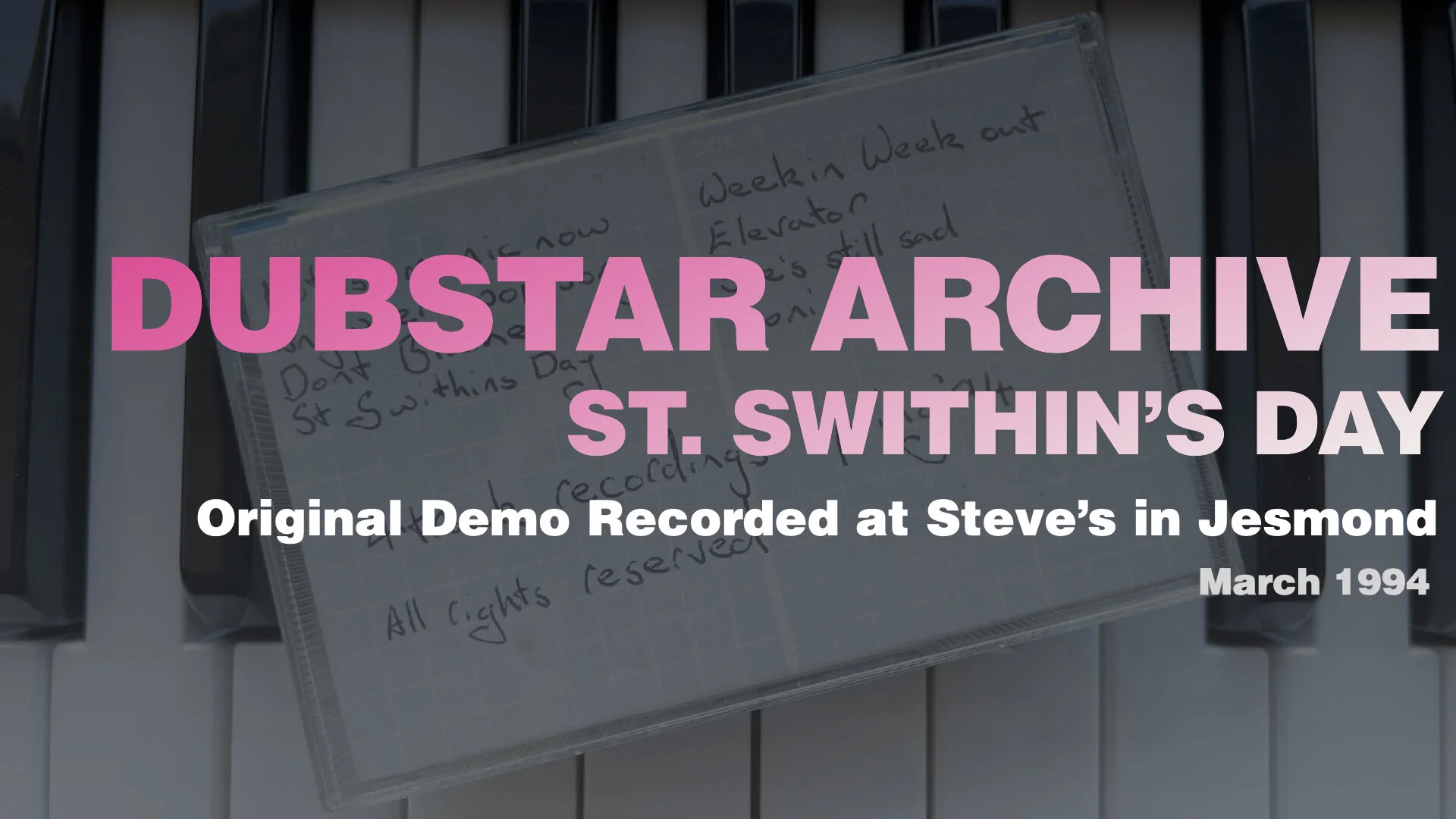
Dubstar: St. Swithin's Day original demo recorded at Steve's in Jesmond


On a Saturday night in August 1996 at around 22.00, Billy Bragg joined Dubstar onstage to sing St Swithin’s Day at the Reading Festival. We were headlining the NME tent, it was the biggest crowd the act would ever play. It was also the culmination of a long journey…
I was introduced to the music of Billy Bragg by my dear school friend David Sullivan in the summer of 1984. He’d come round to my parent’s house in Welling on a Friday night with a vinyl copy of Life’s a Riot With Spy versus Spy. We loved it, played it repeatedly into the small hours. The music was different to the other acts we had in common: we were Gary Numan fans, Cocteau Twins fans, Durutti Column fans but Billy was nothing like these acts other than being an independent artist. A bold London accent that reminded me of Paul Weller, nothing but a guitar to accompany him… not the sort of thing we usually went for but there was something else that caught our imagination and set him apart.
It’s well documented that Billy’s vocal style can be as challenging as it is endearing, it’s fair to say he has a character voice. But there was one thing you couldn’t debate: he meant each word he sung. Every word meant something to him, therefore every word said something to us. And being fourteen, knee deep in teenage angst and about to dive headfirst into our first proper relationships, when Billy sang we listened. He was telling us about his life, so he was telling us about ours.
It also helped that he seemed to be playing somewhere in London every other weekend in the mid 80s. These were the days of the GLC (Greater London Council, not these guys) who would put on free concerts in parks from Peckham to Wimbledon and even as far afield as Hackney. We went to them all, Billy was a regular fixture, as was Smiley Culture. And that dentist bloke with the violinist. These were great times where my love of live music was born.

So we were proper fans, and here began a run of six exceptional and life-affirming Billy Bragg albums that soundtracked my teens and twenties (you’ll find a playlist of my faves here). I was entranced. I wanted to write songs like him, and form an act that sounded like the Cocteau Twins to sing them. Somehow. Looking back now, if you throw in some Charles Aznavour, Smiths, Depeche Mode and a massive slab of Boys Own and you’ll have the perfect Dubstar influences Venn diagram…
Fast forward to 1994. Sarah had replaced me on vocals in The Joans and we were recording demos for gigs in and around Tyneside. The starting point for St Swithin’s Day was the breakbeat and bass line…I’d been lent a Kawai K1m by Sharon Wilson, singer in the other band I was in at the time. I wasn’t much of a fan of the synth, but discovered that if you stripped everything back you could access the built in samples and play them straight from the ROM. I liked the string sample, and was inspired to write a bassline to a break beat from my collection of Ultimate Beats and Breaks albums. It was days later when I was humming along forgetfully that I realised you could sing Billy’s St. Swithin’s Day to it… then it hit me, imagine a dance version of a Bragg ballad, how cool would that be?

Sarah sang it perfectly, and a defining trope of Dubstar was born: woman dispassionately sings the emotionally charged words written by a man. Of course we didn’t know that would be important to the act, we were simply doing what we did…it’s only now after all these years that it’s clear this was a defining aspect of Dubstar.
Later that year Andy Ross of Food Records played the GDR demo of St Swithin’s Day to Steve Lamacq, who in turn played it out on his BBC Radio 1 evening show (I loved the fact that Andy affectionally referred to on air us as coming from ‘oop north’). This was our first play on national radio. It would not be our last.
Two years later and with five Top 40 singles under out belt we were rehearsing to headline the NME stage at the Reading Festival at NOMIS studios in Kensington. Billy Bragg came round to work out how we could have him join us onstage to play the encore of St Swithin’s Day. He strolled in and was charm itself and self deprecating too (“I only sing in two keys, sharp and flat”). Inevitably I said something stupid in response and wanted the ground to swallow me whole. I don’t think he noticed…
It was immediately clear there was going to be a problem for Billy as we’d changed the key of the song. St. Swithin’s Day was now in that sweet spot that was both too hard to sing an octave lower than normal and impossible to sing an octave higher. He had a simple compromise though. Billy would join in on the B sections (“and the fact that you don’t understand”, “the times we all hoped would last”, “the polaroids that hold us together”) which just about fit within both singers’ ranges. Perfect.

I don’t normally get nervous on stage at all, been living there since the age of fourteen. But standing behind my Roland JD-800 onstage in front of six thousand people at the Reading gig I noticed there wasn’t a microphone setup for Billy. I freaked, I couldn’t believe it, he would come on and have nothing to sing into. So during Manic, which we always played early in the set I ran off stage to tell the crew they’d forgotten about Billy…but I couldn’t find them! Aaaggghhh! So for the rest of the set, the most important gig of my life, I was running offstage during each song to find someone, anyone who could sort this out. Of course when I did eventually find the tour manager he reminded me that you wouldn’t have a mic setup for an entire set without a singer, obviously. And that the roadies would set Billy’s mic up for the encore when we were offstage. Obviously.
PS: we recorded another Billy Bragg song on that day back in 1994, something I’d completely forgotten about until rediscovering these cassettes a few months back…
Want more? You can find the story behind every Dubstar song ever recorded including dozens of unreleased songs right here at Dubstar.com
And don’t forget to follow me on Twitter to be the first to hear new releases and up-to-the-minute news

Dubstar: Joni, the song that became 'I Will Be Your Girlfriend'
Joni, the instrumental that two years would become ‘I Will Be Your Girlfriend’ was conceived as an opening tune for the newly revamped The Joans in 1994, now for the first time with Sarah on vocals. I’d written the house piano vamp years earlier, a funky lovechild of the kind of piano parts I loved on Alison Limerick and TransGlobal Underground records. But what made the song come together was the Joni Mitchell sample.
Except it wasn’t a Joni Mitchell sample. I didn’t realise it was a reinterpretation of Big Yellow Taxi until a couple of years later. I was never much of a fan of the 70s, embarassingly for a DJ my musical general knowledge really on began in 1978. If you need someone for your pop quiz who is ‘good at the 80s’ I’m your man, but Beatles trivia? Sorry… prior to the arrival of punk I knew basically nothing. So with a smaple of this nature I was flying blind. An act calling themselves Aquarius had resung Big Yellow Taxi and put it into their own proto trip-hop song Hey Babe…I thought it soudned terrific so I sampled the hook line on my Roland W-30 and strung it together with this modified hip hop break, a bass line from my DX100 and the piano vamp played on a Korg M3R that also added some mad percussion. Chris made some superb guitar shapes and bingo, Joni sounded amazing as a set opener…plus no one else was doing stuff like that on Tyneside in 1994. Dubstar had arrived!
There were plenty of acts in other parts of the country who were making music like this though, and it was these who were the biggest inspirations for the Dubstar sound. I’ve linked to a selection in this blog post…
When Sarah joined us in 1993 it was clear that we would have to refocus our act. Chris and I had spent the largest part of 1993 becoming ever more obscure, noisy and, frankly…unlikeable, musically speaking. And yet there I was writing all these catchy tunes that were trying to escape from oblivion, potential chart gold but framed in noise. Was it my love of My Bloody Valentine and the entire 4AD Records rosta that was holding us back?
I’m not sure, but it became obvious that the best way to incorporate Sarah and do something that might be successful was to move away from the walls of sound and into a world where other people could enjoy these songs for once. In other words, get a grip.
So the shoegaze records were put away and I let the tunes I’d been DJing take over. This was the musical decision that defined the move from ‘The Joans’ to ‘Dubstar’. After ending my ambitions to be a singer, this was probably the most important career decision I’d made.
And in Joni you can hear some of the attributes of the music that would appear on Disgraceful. There’s the tiny vocal sample idea that would open Anywhere, the rolling break beats found in St Swithin’s Day and Stars…not forgetting the huge dub basslines that feature throughout the Dubstar cannon.
Listening to this humble cassette recording, it’s amazing to think it was made on a simple portastudio on the floor in my front room in just one take. You can clearly hear that we were having A LOT of fun… I miss those days a lot too. And sometimes I wonder if Goodbye would have sounded better if we’d added Joni to Goodbye rather than Girlfriend. But that was twenty five years ago, we’ll never know. Maybe Girlfriend could have been the opener to Make It Better? I suppose it’s true, you don’t know what you’ve got ‘til it’s gone…
Want more? You can find the story behind every Dubstar song ever recorded including dozens of unreleased songs right here at Dubstar.com
And don’t forget to follow me on Twitter for up to be the first to hear new releases and up to the minute news
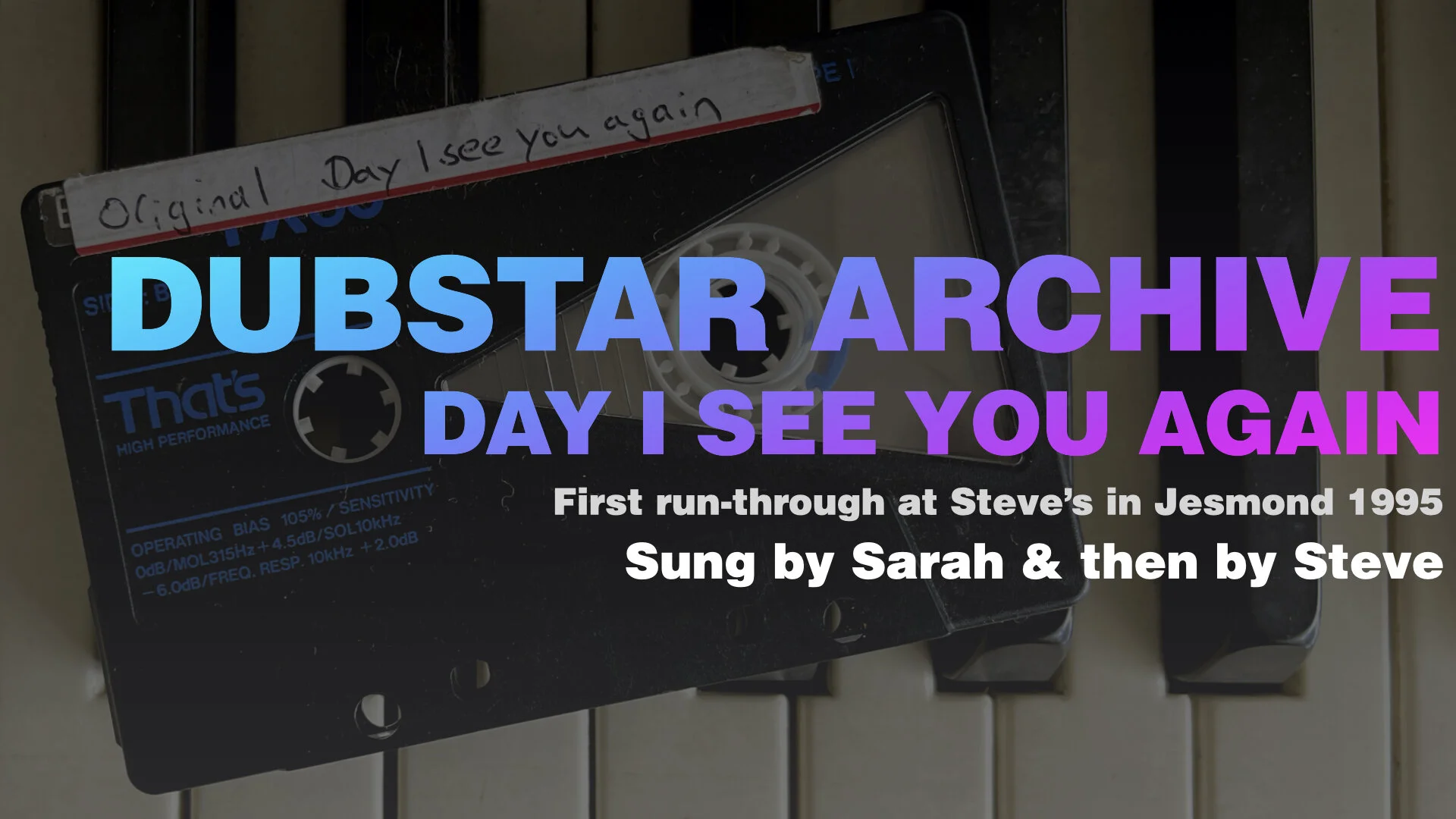
Dubstar: The very first run-through of ‘Day I See You Again’
Day I See You Again was written during the first recording session for Disgraceful at RAK Studios in London. As with so many Dubstar songs, the melody had been jogging around my head for years before the events detailed in the lyric. It took the real day-I-saw-you-again for the words to appear…and become one of the most celebrated Dubstar songs. The lyric appeared in about ten minutes, which is the optimum length of time to write a song. The best work always comes quickly.
Day I See You Again throws a spotlight on a philosophical and artistic consideration I’ve wrestled with since school days: you want to write great songs, so should you be portraying yourself, how you feel, what you’ve done… or should you invent a separate character to be your hero? Can you do both? And if you were to do both, would that compromise the audience’s sense of the singer? Who is that person?
This was an issue for me in the Dubstar days: it wasn’t going to be me singing my words but Sarah, not simply a different person but a different gender too…so should I write from my perspective, or a female character I’ve invented… or what I imagine is Sarah’s perspective?
This troubled me deeply at the time, so I made a policy decision in 1995 that I’ve stuck with it ever since: I would not invent characters in my songs. I would write sincerely in my own voice. Inspired by my musical heroes like Billy Bragg, I realised that in order for my songs to work it’s crucial that the listener believes what the singer is singing is true, whoever that singer is. That truth could only come from personal experience, so I’ll write about that.
But that puts Day I See You Again in a peculiar middle ground. In order for the song to make sense, I wrote it from a straight woman’s perspective fantasising about a man, not a straight man fantasising about a woman. But how can you do that without inherently compromising the song, losing the inner truth? Wouldn’t the gender swap spoil the whole thing?
The solution was to take inspiration from Morrissey, who even gets his name checked in the lyric.
In Morrissey’s work, particularly in The Smiths, he rarely if ever mentions the gender of the person he’s singing about. This leaves a large aspect of the context of the song and the situation open to the interpretation of the listener…is this song about a man, a woman, a forbidden homosexual encounter, a hidden longing? The writer creates these gaps that the listener fills with their own concerns.
It is for this reason that every Dubstar song I wrote after Day I See You Again, there are occasional gender specific references that Sarah makes about herself but almost none about the other person in the song. The story and characters the listener creates will always be stronger than anything I could write, so I left that aspect out.

Jesmond Dene 2021, the park in the valley of the Ouseburn in Newcastle Upon Tyne. This recording was made just above the park in my old flat on Grosvenor Avenue
So how to complete Day I See You Again? Keep the sentiment as if it were me singing about ‘the day I see you again’, but just swap the genders signifiers (“if the man/woman you’ve grown to be…”). This also seemed to contribute to the sense of ‘kitchen sink realism’ that journalists would discuss when the album came out. Perfect for the Britpop era, and completely unintentional.
This recording, found on an old cassette in a cupboard in Hove remained unseen or heard since 1999. It’s the first time Sarah sang the song, you’re hearing the very first run through. We were in the front room in my flat in Jesmond…as usual I’d kept writing songs for inclusion on our first album even though the track listing was pretty much confirmed at this point. It was composed on my piano in the front room but I’d made this faux Russian orchestral arrangement on the Roland S-760 sampler so it might round off the album with a contrasting and sophisticated mood.
One rainy Tyneside afternoon I sang it to Sarah and she sang it back to me. That’s what you can hear here. I left the tape running after Sarah finished and sang it again so we could firm up the rhythm of the words and have a recording she could take home. This is the last recording I made of my own voice singing a new Dubstar song for more than a decade. The next time was for the sessions that would become the first unreleased album United States of Being in 2006.

The room where Day I See You Again was composed, it’s now a students’ flat this picture being from the estate agent’s website 2021
A few interesting things in this recording:
This version of Day I See You Again includes the full third verse, half of which was edited out by Graeme Robinson. At the time it seemed that the last verse no longer made sense…now I’m sure it was the right decision.
It also includes the original instrumental Middle 8 section which we replaced with a double chorus. It’s quite clever, the same vocal melody and words but entirely different accompaniment. I talk about this in my songwriting lectures….
Both Sarah and I struggled to get the words to flow and spent ages fitting them to this slow 3:4 arrangement. This explains the slightly wonky performance on Disgraceful where the song has been straightened out to 4:4. It has a certain charm though, who wants perfection in art?
The key was a bit high for Sarah, so when I demonstrate how to sing the song it’s WAY too high for me. Hence my exclamation at 6’39” of ‘fucking hell, no wonder you’re the singer’ with Sarah laughing in the background. What I meant was ‘no surprise I’ve stopped singing and you’ve taken over, I can’t do this and you’re way better at this than me’. I’m not sure that comes across on this recording. Glad I can clarify it now, better late than never.
It’s amazing to have found this among the dozens of cassettes-in-the-cupboard, the first run through of a pivotal Dubstar song…sixteen months later Sarah would sing it as an a cappella encore headlining the NME tent at the Reading festival. The roar of that crowd, the sheer power in the affirmation of that moment is a memory I treasure nearly twenty five years later.

The official poster for Reading Festival 1996
Want more? You can find the story behind every Dubstar song ever recorded including dozens of unreleased songs right here at Dubstar.com
And don’t forget to follow me on Twitter for up to be the first to hear new releases and up to the minute news

Dubstar Preludes Volume 3 Preview: Make It Better
Dubstar at 25+1: Dubstar Preludes Volume 3
Over thirty demo recordings were completed for the third Dubstar album ‘Make It Better’. With Chris living in Gateshead, Sarah in Manchester, and me down in Hove we were as far apart as you can be while still in England*.

All three members of Dubstar in one place
There was another problem too:
My songwriting portfolio was empty… Disgraceful and Goodbye included many songs that were up to ten years old, in fact only two songs on Disgraceful were written for the album, ‘Not Once Not Ever’ and ‘Day I See You Again’. It was a similar story for Goodbye. This meant all of the songs for Make It Better had to be brand new compositions** .
So after I abandoned our ‘challenging’ writing trip to the mill in Oxfordshire (Dubstar never wrote together, what were we thinking?), I sat down in my new flat in The Brunswick development in Hove. I wrote fifty seven new tunes for the album including a collection of instrumentals that I would write words for at a later stage. That’s not so many for a professional writer, but writing as a recording artist requires a different mindset to someone who writes for money. For me, great music depends on a connection to something personal, something real, something true…after all, songwriting is an art. Art takes time, patience, and a space to indulge yourself.
Whereas a pro-writer must come up with golden ideas every time she’s in a writing session, to somehow be more general yet simultaneously edgy, commercial but not cheesy. This is not an easy task. I lived in that world for a while and it was the hardest I’ve ever worked.

The writing setup for United States of Being, the follow up to Make It Better. Note the return of the piano.
But back to Dubstar… In some ways constant writing is a reflection of a lack of confidence, you think that eventually you will write the next Winner Takes It All, the next I’m Not In Love, the follow up to Stars. You know you can do it, you just haven’t managed it… yet. It will be the next song, next song. But as any writer knows, you get to a point where you can’t trust your own quality control. And if you’ve not hit your best work after fifty songs it’s probably not coming. There comes a point when you simply can’t make it any better, you have to demo together, you have to commit to the songs you have.

Steve and Chris rehearsing in Brighton. Photo taken by Sarah of course
To complicate things further, my writing process had changed since Newcastle. I’d left my piano back in Jesmond, so I was writing on synthesisers and guitars for the first time. This was exciting but brought challenges. The record company had bought us a brand new Apple Mac G3 which was incredible. The previous two albums had been put together using ADATs, Cubase on my Atari ST and of course the Roland W-30. This was the modern world, this was Logic Audio V3. This was…a lot to get my head round.

Single artwork for Make It Better, the preview single for DUBSTAR Preludes volume 3
There was no rehearsing of the songs on Make It Better. Essentially I would create the whole arrangement alone, Chris would make trips down to play on what were effectively finished instrumentals. Sarah would arrive another day where I would sing the melodies to her…and that would be the very first time the song would be heard, not just for Sarah but for me too. Madness really, I wouldn’t countenance working like that today. But we were geographically separated, the situation required a compromise to work at all.
After thirty two songs were demoed, I think we were all at the end our tethers. I wanted to keep writing but the time had come to start recordings proper. So I stopped.

My Fender Rhodes, as featured on Make It Better
What this meant was there was a huge backlog of unfinished and undemoed songs written in this period that were never heard. That’s where DUBSTAR Preludes Volume 3 comes in. These are the best five of the twenty five (!) unrecorded songs from the Make It Better era.
Make It Better, the song itself, is a preview from the prelude, a direct update of the original recording from 1999. You can hear my bass and guitar parts recorded at the time, while the melody is played out in 2021 on my Fender Rhodes with extra supporting parts added to complete the sound. It’s a little scratchy, but those initial recordings were never intended to appear in this form. I think it has a certain charm, I hope you agree.
*Unless one of us was in Cornwall. Or Devon.
** (except ‘Your Words’, which wasn’t a particularly strong song anyway)
Want more? You can find the story behind every Dubstar song ever recorded including dozens of unreleased songs right here at Dubstar.com
And don’t forget to follow me on Twitter for up to be the first to hear new releases and up to the minute news

Dubstar and Human League at Tynemouth - The Final Gig
Dubstar at 25+1: The Final Gig
…and a heatwave on Tyneside
We played our last gig of the twentieth century on Wednesday 12th February 1998 at the Norwich Waterfront. The tour to promote ‘I Will Be Your Girlfriend’ had not been a happy excursion. For an act that was more a studio creation than a live experience we’d played a remarkable amount of shows in short succession. By my reckoning we’d completed nine tours in three years. This outing was the last time that we played with the extended line-up of Rochelle Vincente on backing vocals and Sleeper’s Diid Osman on bass (not forgetting the amazing Paul Wadsworth on drums of course). And on that final show in Norwich it was Diid’s birthday, the band sang ‘happy birthday’ to him on stage while the audience gazed on, baffled.
That was it until we shared a stage for Miles Jacobson’s Birthday (erstwhile of Food Records, now Managing Director of Championship Manager) in November 2011. A long thirteen year hiatus for Dubstar, but we’d taken a breather and now we were back. Next we headlined the Riverside fundraiser at the Cluny in Newcastle on August 29th 2012, then the big comeback show at the Lexington Pub in London on 15th April 2013 and finally ‘The Mouth of the Tyne’ festival at The Priory at Tynemouth with the Human League. We didn’t know it at the time but it was to be the farewell…

Dubstar at the Riverside Fundraiser, Cluny, Newcastle 2012
After the abandonment of the act and first United States of Being album in 2008, the coterie of advisors we’d grown around us evaporated, but I’d kept on nodding terms with Simon Watson, the Human League’s manager. A fellow resident of Hove, our paths had crossed on a handful of occasions, I think Sarah knew him from her days singing for Client too. He had a proposition:
“The Human League are playing in Tynemouth, would Dubstar be available to support?”

It was an intriguing idea. As an act we’d already begun to drift apart again, Chris was up north, Sarah in London and me settled in Brighton… but we said ‘yes’, why not? And playing home turf again (Chris was living literally across the road from the venue) would be great.
So on July 10th 2013 I travelled to Newcastle by train, Sarah and Paul B brought up my equipment by car. That evening I met some old friends from the Newcastle music scene at the Cluny and made a presentation at a music conference nearby. The following day, slightly bleary-eyed we completed one sweltering and very quick rehearsal at Gavin’s studio Base HQ in the Armstrong Industrial Park, just as we had the previous year for the Riverside show. We were hot and bothered and ready.
The day of the gig was even hotter.
The dressing room was in the disused Coastguard Station and was enormous, with the most incredible views of the North Sea and the Tyne river. We had the back rooms, the Human League the main observatory which was even bigger. Our vegetarian curry was delivered after soundcheck, and as I sat there eating alone I had to laugh at the very Dubstar nature of the situation. We were playing in Tyneside, but not Newcastle, opening for an act I’d adored as a child but had lost track of. We had an incredible view, but through someone else’s dressing room. I was sure I’d been here before….

Waiting to go onstage…the view from the Coastguard building at Tynemoth (Chris, Sarah and Paul B)
The show went well, everything was smooth, I only played half a dozen wrong notes. It was a short ‘greatest hits’ set plus Window Pain, an unreleased song from our second completed United States of Being album.
Using the venerable Prophet 600 for bass was a bold move, it felt like the earth was moving for the closer Stars. I looked down at the crowd, literally, who were mainly families picnicking in the fading sun, kids running around with their parents occasionally nodding their heads. This was how we’d started all those years ago and it somehow seemed to be the future for Dubstar too, playing old songs to fans of other bands. Hmmm…
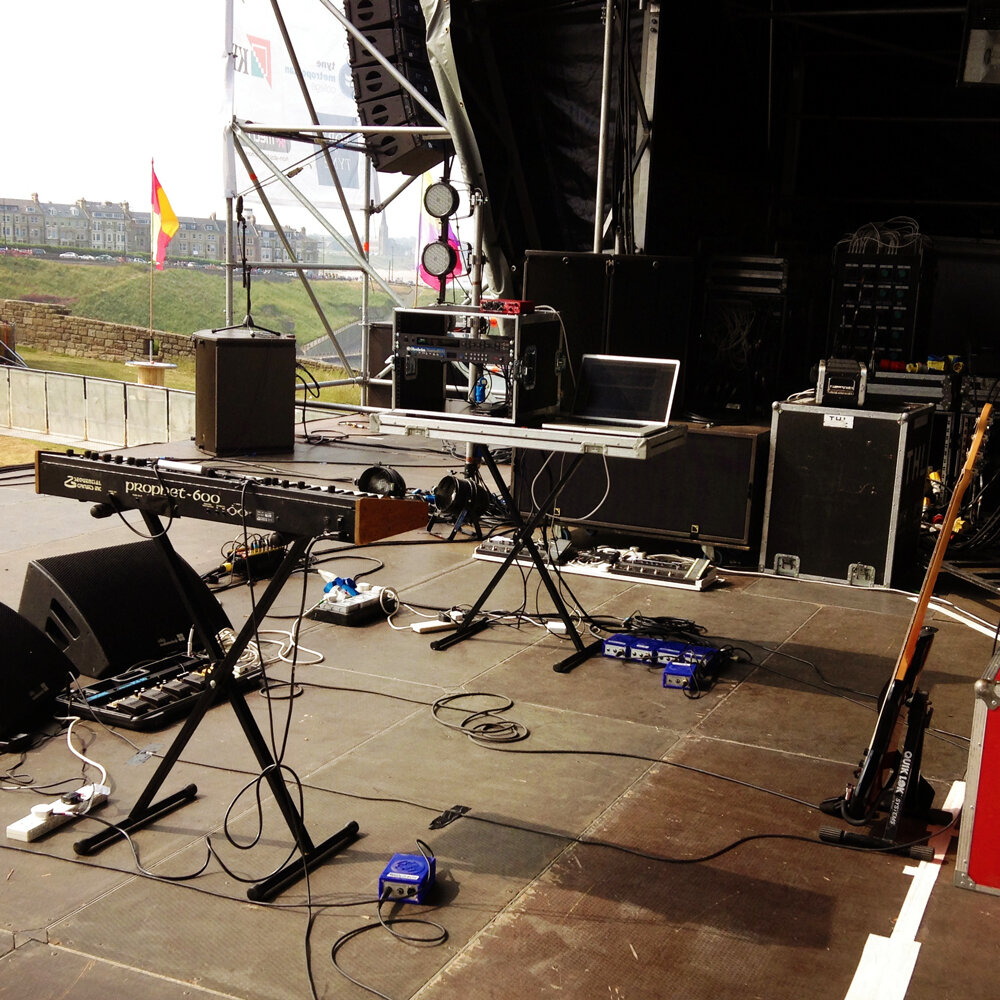
Inevitably Human League were amazing, you can’t argue with Being Boiled, Empire State Human or Love Action. And why would you want to? I was a little irritated they included ‘Together In Electric Dreams’…I’m an original fan, I bought Reproduction on vinyl in 1979 and that’s not a League song! The crowd loved it of course, no one cared no matter how hard I frowned. Phil thanked us from the stage which was a thrill, and from deep in my memory a voice was telling me ‘one day all records will be made this way’.
The show was over by 21.00, remarkably early. We’d nearly finished the rider and were simply hanging around as I watched the League pull out of Tynemouth. Jo and Susanne were walking the grounds of the Priory with multiple champagne bottles under their arms, Susanne calling out ‘Phil, are you coming back in our car?’ The luckiest women in pop indeed…
I strolled out into the evening heat to sample the delights of Tynemouth, a place I knew well but had never explored at night. The town was heaving with League fans in t-shirts in the sweltering heat, the atmosphere electric. Normally I loved the post gig banter with fans, but tonight I wasn’t inclined, because…

Tynemouth Priory in a heatwave
…Dubstar had just completed a circle with a circumference of decades. We started on Tyneside twenty two years earlier, left Newcastle, travelled the world and now we were back where it all began. And yes, It was great to play with the Human League, an honour, but I couldn’t shake the nagging thought that I’d already done this years ago. An entire generation ago.
So I went out to the benches on the promenade with the final beer from the rider and listened to the music I had on my phone. The songs Emma and I had been working on, the Dog in the Snow productions, the Hockeysmith songs, my own new material, ghost writes I’d completed…
And although I’d realised this the previous year, now I could feel it and I could see the evidence all around me. There was no angle to grow Dubstar from here, at least not in a way that would work for me. The circle could keep turning but would only ever be a border, an impassable frontier defined by all we’d accomplished decades earlier. That was the exact opposite of what Dubstar was supposed to be.

I looked out through the haze to the sea and the ships queuing to enter the ‘Port of Tyne’… this wasn’t a sad moment. It was elating, the dramas were complete, the struggle was over and the journey had been great. I finished the beer, put my headphones on and slipped away…
Want more? You can find the story behind every Dubstar song ever recorded including dozens of unreleased songs right here at Dubstar.com
And don’t forget to follow me on Twitter for up to be the first to hear new releases and up to the minute news
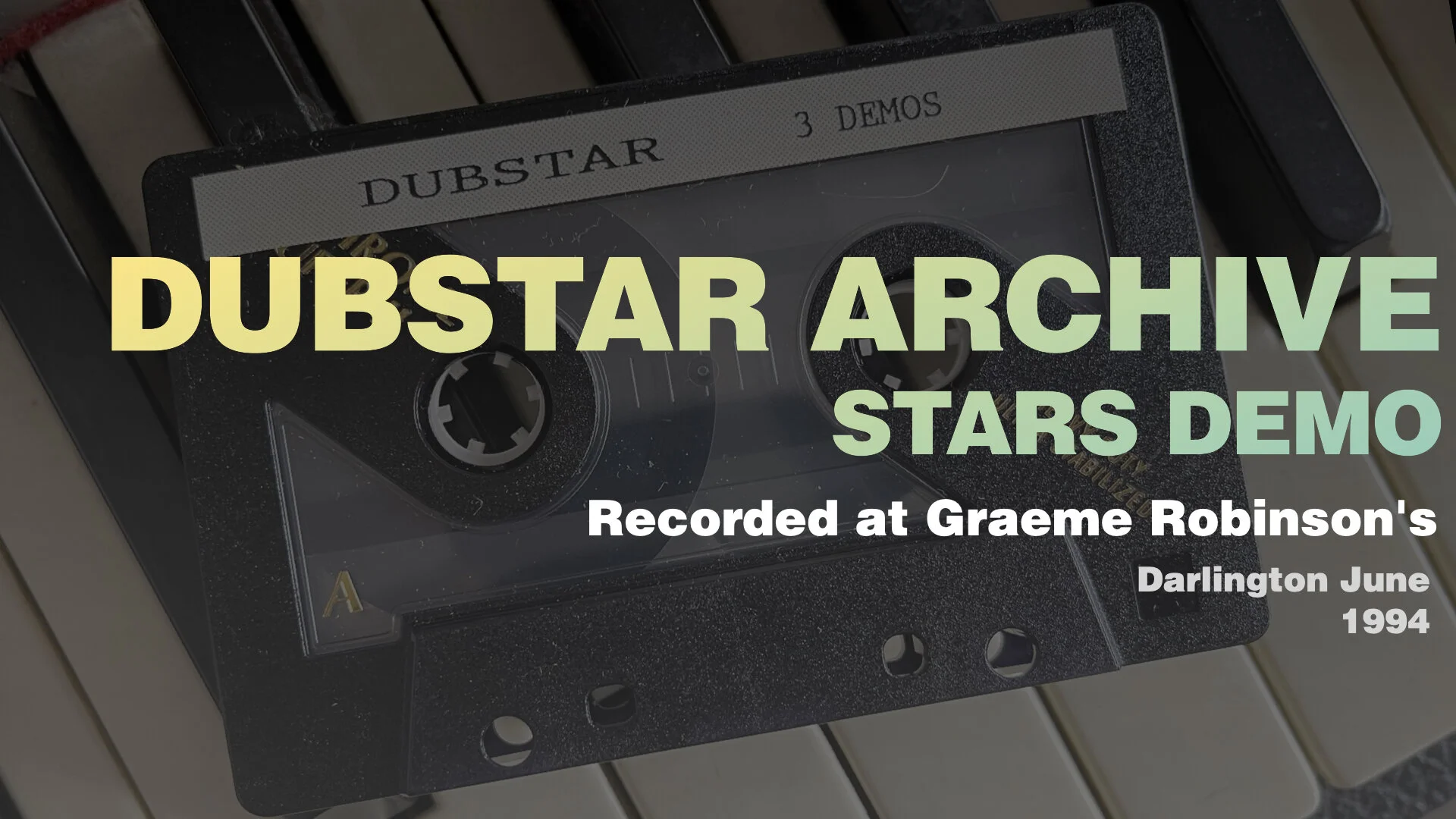
Stars - Demo at Graeme Robinson's house in Darlington June 1994
I wrote ‘Stars’ in early 1992 as a reflection of my concern of what to do when Walker’s Nightclub closed. It had been my home for three years, and suddenly it was gone. Three years later, on this day in 1995 it would be the first Dubstar release and the first time we made it into the UK Top 40. It would go on to be the most successful of all the Dubstar songs.
There were many versions of Stars, last time I counted there were over twenty remixes. And prior to our debut on Food Records there were half a dozen other versions too. On these cassettes next to me I have two live takes and a studio recording with me on vocals, a run-through from Jesmond and a live version with Sarah singing, and this…the demo that was taken to Camden Town in June 1994.
It was recorded in Graeme Robinson’s back room in his house in Darlington. He’d invited us to make some demos with him and his sidekick Jon Kirby having seen us play at the Riverside a few weeks earlier. There was some talk about taking these tunes being played to record companies…we knew he was the drummer in a Food Records signing called ‘Planet Claire’ (fronted by Claire Worrall who went on to play keyboards in Robbie Williams’ band and is now married to one of my musical heroes Stephen Duffy).
But we weren’t thinking anything much would come of this trip to County Durham. In the world of music, thing’s normally don’t.
So I took my Roland W-30 sampler down the A1M and laid the entirely programmed arrangement onto Graeme’s tape machine. Chris is playing on this demo somewhere but is mixed so low I can barely make him out, Sarah sings well though.
In the earlier versions of the song there was no middle 8, so Graeme suggested I wrote something new to break up the choruses that repeat towards the end. Unfortunately I couldn’t think of anything. I have a problem revisiting old songs, something to do with a short attention span I suppose, and this one had been around for more than two years at this point. All I could think to do was pause, maybe take a break from the singing? It was supposed to be a ‘Dub’ song after all…consequently this became the defining structure for Stars.
We recorded three songs in that first session, I think they were Stars, Anywhere and Elevator Song. Jon drove Graeme down to London to meet Andy Ross at Food, and then back up to mine in Jesmond. He had some good news…
If you’d like to hear more excerpts from the Dubstar Archive and new releases from me please like and subscribe to my channel on YouTube and Instagram.
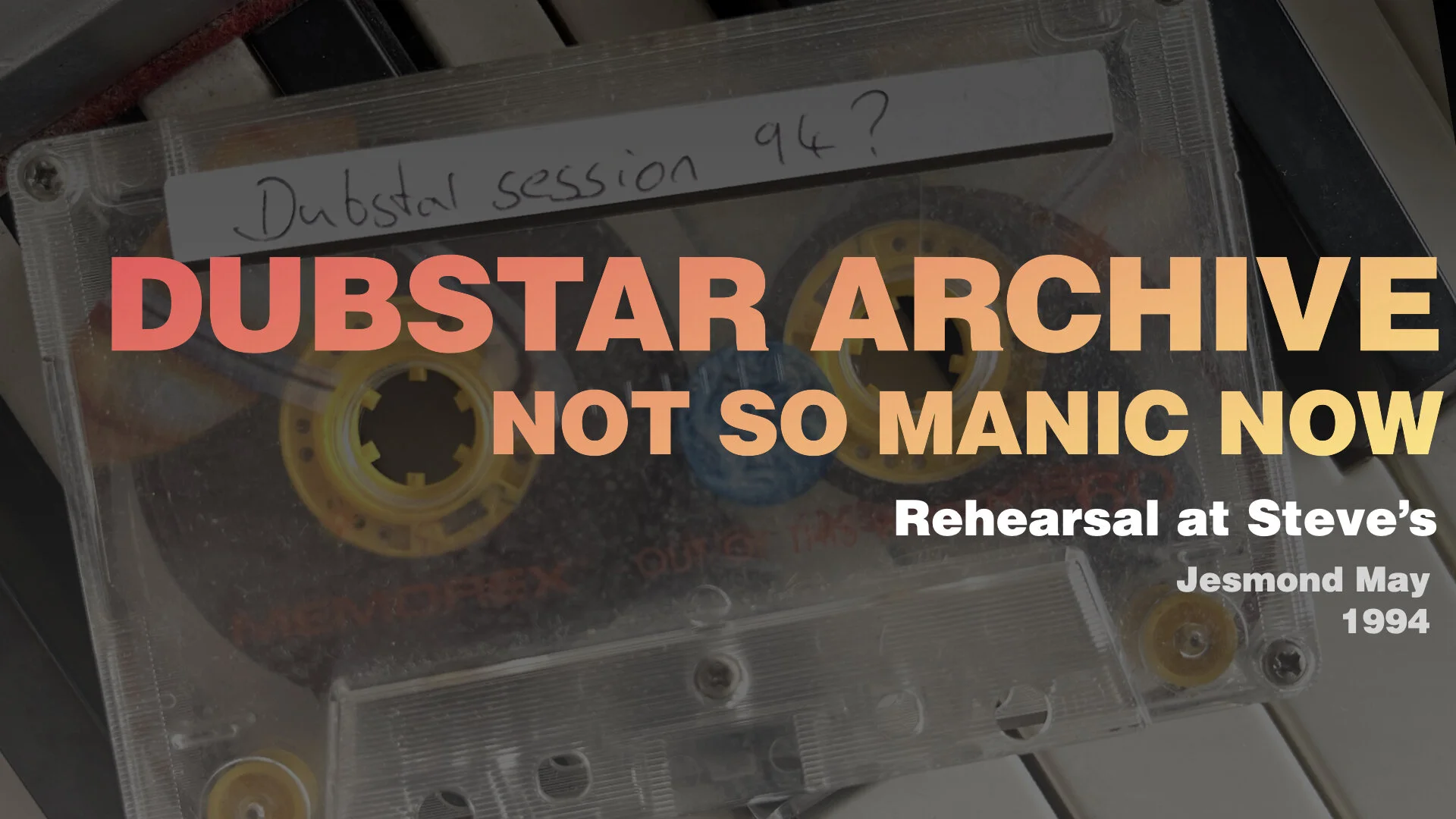
Not So Manic Now - Rehearsal at Steve’s in Jesmond May 1994
The first release form the treasure trove of cassettes I found last month!
During the first half of 1994, and prior to singing to Food Records, Sarah, Chris and I were performing regularly across the North East of England and rehearsing in the lounge of my flat in Jesmond. I don’t recall why we stopped working in the local rehearsal rooms, but I know that on this occasion we needed to record the live set as demos for more gigs. The whole recording survives to this day on my cassette.
The gig was at Rumpoles in Middlesbrough the following Saturday. There were eight songs: we opened with ‘Joni’ (which two years later would become ‘I Will Be Your Girlfriend’, ‘Manic’ was number four and we closed with ‘St Swithins Day’. For some reason ‘Stars’ wasn’t in this set…
At the gig I was enjoying myself and thinking ‘we’ve actually got something here’. It was the first time that the act had really come together live since Sarah had joined eight months previously. The crowd seemed to love it, even the bar staff. Unfortunately, apart from one show at Newcastle’s Riverside later that month we wouldn’t play live again for well over another year. Damn.
This is the original arrangement for Manic that I discussed on dubstar.com. More upbeat than the version on Disgraceful, it’s way more fun but lacks the majesty of the single released eighteen months later. Despite this version obviously being a work in progress, you can clearly hear Sarah relishing the song.
My strongest memory of this time is the cognitive dissonance of believing we were finally getting somewhere, this act sounds good… and days later waking up on my 25th birthday thinking this act is doomed. I’m too old, it’s never going to happen. It was literally the next day that Graeme Robinson invited us to work with him in Darlington, which led directly to us being signed by Food Records with months.
There’s a lesson in that…
Want more? You can find the story behind every Dubstar song ever recorded including dozens of unreleased songs right here at Dubstar.com
And don’t forget to follow me on Twitter for up to be the first to hear new releases and up to the minute news

DUBSTAR Preludes Volume 2

Almost all of the early Dubstar songs began their lives in my home in Jesmond, Newcastle Upon Tyne. I was lucky enough to share an entire Tyneside flat with just one other person which gave us both a huge amount of living space, a dream at only £120 a month each.
With this luxury I would write the song on the piano in the front room with the view of Jesmond Dene, then put together an arrangement on the Roland W-30 sampler in the back room later that day. This working process gave us Disgraceful, Song no.9, Stars, Day I See You Again, Anywhere…almost all the songs on Disgraceful.
Goodbye was slightly different. In 1995 I moved the equipment out of the flat and into our first studio in the Newcastle Arts Centre on Westgate Road, directly over the Star Inn pub. The following year when the time came to record the B-sides to Elevator Song, the studio moved to a much nicer room in the main quad of the centre (with heating!). Rental per week? £20. I maintain to this day that one of the best things Dubstar ever did was not move to London…
Consequently for the second Dubstar album there was a longer delay between the writing of the songs in Jesmond and demoing them in the studio. Whereas previously everything I had written had some sort of arrangement made the same day, in 1996 there were dozens of tunes that started their lives at home but were never completed. Not even demoed…
This is where Dubstar Preludes Volume Two comes in.
During the Covid-19 pandemic I’ve had the time to listen through the Minidiscs and DATs of tunes that I started writing for the act but ran out of time to complete. It’s amusing to reflect that even though Goodbye was way too long at fifteen tracks, there were still piles of other tunes waiting to be completed in the wings. As I said to the head of Food Records…”there are always more songs Andy, and some of them are good”.
So here are my favourite four of those compositions, each written twenty five years ago in the late Spring of 1996. I hope you enjoy them:
There was never a Dubstar instrumental. Sarah was the star, it wouldn’t make sense to have her missing from a Dubstar tune. But Infinite Summer was written with this destiny in mind, just to try something different. I had plenty of problems to write about but I was concerned that our audience might be getting tired of hearing Sarah singing my state of mind. Hmmm….
So Infinite Summer was written as a guitar instrumental, possibly as an opening song to the new album. The fact that it sounds nothing like anything that eventually made it onto Goodbye explains why we’re hearing for the first time now.
I included this tune in my GGGGHOST live sets in 2015-17. The original idea was to have one simple motif repeating throughout the song (the doo-deeeeee-dah melody) and then write a vocal to sit on top. But there wasn’t enough musical space to insert another melody, so I didn’t try. A rare case of harmonic restraint from me. Also, I was shying away from doing another spoken word piece like ‘Unchained Monologue’, so it was forgotten for twenty years.
On the original minidisk you can hear Lee and Herring’s “Fist of Fun” playing in the background. Can you get more 90s than that?
I had hoped that Dubstar would record a dance anthem (with words) for the second album. We’d gotten some of the way there with the Motiv8 version of ‘Stars’, but that song was really a slow, dubby ballad. This new song would be written from the get-go at a dance floor friendly 125BPM. It would also have an uplifting-rather-than-reflective-melody that would land us smack-bang into the front of the record boxes of the super star DJs. That didn’t happen of course, I was distracted by the Britpop activity around me so wrote more sad-anthems instead.
This piano piece arrived on a cold early morning in Jesmond when things weren’t great, at least not for me. So I played a melody with an accompaniment that was straight 8th notes all the way through, something I’d been avoiding for years as it sounded too much like Shoegaze (which I love, but Dubstar couldn’t be shoegaze). No such restraint now.
Sunset on a Family is the sound of an unseen child moving through my victorian flat, a future ghost simultaneously sadder and older than its years.
Want more? You can find the story behind every Dubstar song ever recorded including dozens of unreleased songs right here at Dubstar.com
And don’t forget to follow me on Twitter for up to be the first to hear new releases and up to the minute news

DUBSTAR: Lost & Foundland Volume 3
With the re-release of ‘Stars’, it was on 24th March in 1996 that Dubstar achieved our highest chart position in the UK Top 40.
And to commemorate, today sees the release of the last instalment in the DUBSTAR: Lost & Foundland trilogy, an idea that began as a misunderstanding & blossomed into a suite of piano pieces… memories of the songs that I wrote & then recorded with Chris Wilkie & Sarah Blackwood when we were Dubstar.
It’s been a fascinating journey. Covers excepted, all of these songs started their lives alone with me in front of a piano…and went off into the world to have a life of their own. DUBSTAR: Lost & Foundland has felt like I’ve called them home from a journey across time & space courting producers, engineers, band members, record companies, fans…
And now they’re home, sepia crystallisations of memories from a long, long time ago.
I didn’t return to or reference the Dubstar recordings to make this trilogy, these are how I recalled the tunes, and mainly without the words. Those were from another lifetime…reenacting them now would be reciting lines from a diary. No, not a diary… mimicking the sounds you made & thoughts you had as a younger & foolish person. Bon mots from a VHS of a birthday party, Christmas with the family, words that could only exist in their specific callow context, a land forever lost.
Then found again, as if you were climbing into your loft for the first time in decades.
I hope you’ve enjoyed these recordings, they’ve been an enjoyable obsession for me during this pandemic…the first occasion in thirty years that I’ve actually had the time to look back & assess how far we came. And as the pandemic feels like it’s subsiding there’s a new vista coming into view. New horizons and a new soundtrack, & all of it arriving very soon.
Thanks Dubstar.
Want more? You can find the story behind every Dubstar song ever recorded including dozens of unreleased songs right here at Dubstar.com
And don’t forget to follow me on Twitter for up to be the first to hear new releases and up to the minute news